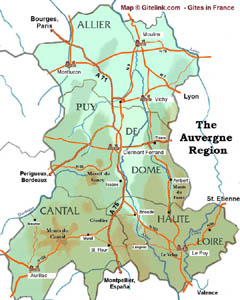
Admistrative Departments of Auvergne - The four
counties
The
Auvergne (historic region) consists of
four
departments or counties :
the Allier,
the Puy de
Dôme, the Haute
Loire and
the Cantal
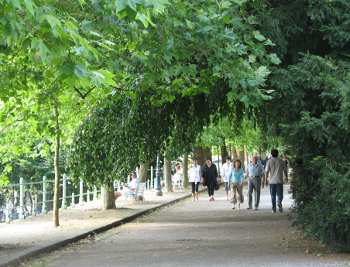
Leafy walk in the elegant spa town of Vichy, in the Allier
The
Allier in
the north - mostly an area of plains and valleys, with small
hills and good agriculture, covers more or less the historic
province of Bourbonnais, the original fief of the Bourbons, one of the
largest royal families of Europe. The Allier is best known
cities
are Moulins, Montluçon and Vichy.
Moulins
,
lying on
the river Allier, is
very much a city of central France, in the style of the towns of the
Loire valley. Montluçon and the nearby town of Commentry
expanded in
the nineteenth century on the back of a coal-mining industry.
Vichy,
also on the river Allier, is a famous spa town with something
of
an old-fashioned atmosphere. It was the capital of "free" France during
the second world war, while the north was under Nazi occupation - a
role that it prefers to forget today. It prefers to brand
itself
as a relaxed place where people still come to take the waters or go to
the races.... rather like a small French version of Cheltenham. The
eastern edge of the department is a hillier area, with a small area in
the extreme south east of the department reaching over 1000 metres in
the Monts de la Madeleine, bordering on the Puy de Dôme.
The "
Puy
de Dome" in
the middle - largely mountainous, but with a large fertile agricultural
plain, the Limagne, in the middle, to the east of
Clermont Ferrand.
With its tall old houses built of black volcanic stone,
Clermont-Ferrand, a city of about a quarter of a million inhabitants,
is the
home of the Michelin tyre company, and a rather austere city;
it
lies at the juncture between the fertile agricultural plain
called the Limagne, and the Massif Central mountains behind and is
dominated by the 1500 metre Puy de Dôme, a massive dormant
volcano.
This is the most famous peak in the "chaine des
Volcans",
the largest dormant volcanic region in western Europe. South of
Clermont lies the Massif du Sancy, a small alpine-looking cluster of
mountains slightly higer than the Puy de Dome itself, and culminating
in the
Puy de Sancy,
at 1885 metres, the highest point in the central
part of France.
The western part of the Puy de Dome
department is an upland area, well watered by the rain brought in on
Atlantic airstreams. It is an area that traditionally remains green and
mild in the summer. The waters that have fallen on these hills and
mountains over the centuries emerge, well mineralised, at famous
springs in towns such as Le Mont Dore, Volvic, or Saint Nectaire.. In
the south of the department, bordering on the Cantal, lies an area
known as the Cezallier, an area of high prairies not unlike parts of
the American west, and a land grazed by large herds of cattle.
The eastern part of the department, east of the
river Allier, is an
area of high ground, the Monts du Forez, which, as their name suggests,
are largely covered with spruce forests. The small city of Thiers, to
the east of Clermont-Ferrand, is reputed as the knife-making capital of
France. In the past, the cutlery industry was powered by the water of
streams and rivers gushing down off the mountains.
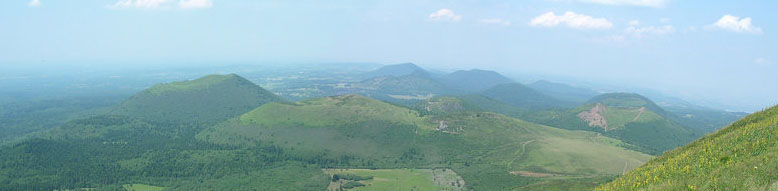 The "Chaine des Puys" - looking from the Puy de Dome
department towards the
Allier.
Photo Romary - Licence CC
The Haute Loire
The "Chaine des Puys" - looking from the Puy de Dome
department towards the
Allier.
Photo Romary - Licence CC
The Haute Loire
in
the south east, the driest and sunniest part of the Auvergne, a lot of
it at an altitude of over 800 metres. Virtually the whole department is
hilly or mountainous, and a lot is forested. The northern area is
centered round the market town of
Brioude,
with its magnificent
romanesque basilica, the largest in the region. South of Brioude lies
the "
Haut Allier",
a region with deep valleys, a generally warm
and sunny climate and a definite flavour of the south of France.
The southern part of the department is known as "le
Velay"; its
capital,
Le Puy en Velay, was a major
pilgrimage centre in the middle
ages, a starting point on the route to Santiago de Compostella, and to
this day the city's cathedral and St Michael's chapel remain remarkable
examples of early mediaeval architecture. Robert Louis Stevenson set
off from Le Monastier, just south of Le Puy, in his famous travelogue
"Travels with a donkey". In the south, the Haute Loire
borders on
the department of the Ardèche, and the top of the Cevennes
mountains.
The Cantal,
in
the south west, is the highest of the four departments, a lot of it
over 1000m altitude. The department boasts two main centres, the
bustling market town of Aurillac, the department's capital, to the west
of the high mountains, and Saint Flour, an ancient town perched
dramatically at the top of a volcanic outcrop in the east of the
department, and visible from the motorway. The centre of the Cantal is
dominated by the Plomb du Cantal and the peaks around it, a massive
volcanic cluster marking the heart of the Massif Central mountains. The
Plomb du Cantal is very accessible, as it rises above the ski resort of
Super Lioran, which is just beside the main trunk road between Clermont
Ferrand and Aurillac. The department is famous for its cheeses, notably
the eponymous "Cantal" cheese, and the delicious Auvergne Blue - bleu
d'Auvergne - much of which is produced in the Cantal
highlands.
Another Cantal monument is a famous viaduct, the Viaduc de Garabit,
designed by Gustave Eiffel. The viaduct spans the gorge of the
Truyère
river, and can be admired from a special visitor centre on the A75
motorway
©
Gitelink.com

 Auvergne
guide
Auvergne
guide